

Scamp
Scamp
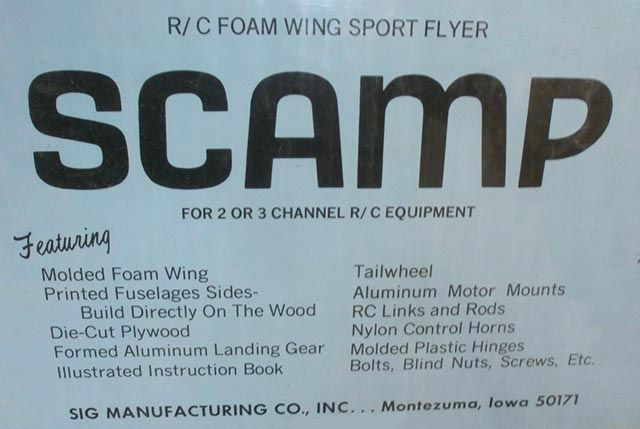
A radio control sport model with a wingspan of 45 inches and a wing area of 290 square inches. Designed for .09 to .15 engines.
Overview
The Scamp is an easy-to-build 3-channel sport model featuring stable and docile flight characteristics, perfectly tailored for the "Sunday flier." While it’s not recommended as a trainer, it can be effectively handled by relatively inexperienced pilots with limited R/C flying hours. Engines ranging from .09 to .15 cu in are ideal for powering the Scamp.
Radio Equipment
For optimal performance, we recommend installing 3-channel radio equipment in your Scamp to control the rudder, elevator, and engine throttle. Alternatively, you could install 4 or more channels and utilize only 3 of them (refer to the RADIO INSTALLATION section on page 13). The fuselage is spacious enough to accommodate a standard-sized battery pack and servos.
You may also use 1 or 2-channel radio equipment, but this offers significantly less control flexibility (rudder and elevator with 2 channels, rudder control alone with 1 channel). We do not recommend 1 or 2-channel operation except for experienced fliers familiar with that type of limited control.
Construction Guidelines
Before Beginning Construction: A full-size plan of the fuselage, showing both side and top views, is included with the kit. Cut the two sections apart, aligning and carefully taping them together along the A-B break line. Use a straight edge along the fuselage datum line to ensure straight alignment.
Preparation: It’s advisable to read through the entire instruction book and carefully study the photos and drawings before starting your build. Working on several pieces simultaneously can be more efficient; while glue is drying on one section, you can progress on another. Familiarize yourself with the instructions and construction illustrations to identify tasks that can be done concurrently.
Reference Orientation: Any mention of right or left refers to your right and left as if you’re seated in the cockpit facing forward.
Cutting Techniques: Start by cutting long pieces of balsa, followed by medium lengths, before trimming full-length strips into shorter pieces. Carefully remove the plywood die-cut pieces; if you encounter difficulty, do not force them out. Instead, use a modeling knife to cut them free.
Cutting Parts: A jig saw is ideal for cutting out the printed sheet parts. Cut just outside the lines, leaving the markings on the part. Use a sanding block to achieve an exact fit when assembling parts. If a jig saw isn't available, a modeling knife can be used, but be cautious not to cut too close to the line—leave enough margin for precise trimming.
Building Board: A piece of Celotex-type wallboard makes an excellent building board, allowing easy pinning of components. Ensure the board is laid flat on a stable surface. Pins can be pushed through all balsa pieces without damaging them—any holes will fill during painting and sanding.
Essential Tools
An essential tool for construction is a large sanding block that can accommodate a full sheet of sandpaper. Use screws along one edge to secure the sheet in place, allowing for easy replacement. We recommend using 80 grit garnet paper for general construction tasks.
With these guidelines, building your Scamp is not only straightforward but also a rewarding experience!